How Much of Your Mind Is Actually Yours?
How Much of Your Mind Is Actually Yours?
Over the past few years, I’ve noticed that a lot of things that used to be a completely normal part of my life have disappeared.
I don’t watch the news or reality TV anymore. I don’t have personal social media accounts, and I only use Instagram and Pinterest for Grounded Studio 555. Right now, I barely listen to music either. It has mostly been replaced by podcasts, but also by something I used to have much less of: silence.
I never made some big decision to remove information, entertainment or outside influences from my life. It happened slowly as my own life changed. I simply started noticing that many of the things I used to consume almost automatically didn’t feel like things I wanted to keep letting into my mind anymore.
And somewhere along the way, I started wondering:
How much of what goes on inside our minds is actually ours?
We Consume More Than Food
We talk a lot about what we put into our bodies. What we eat, what we drink, what we might need more of and what we might need less of.
But I don’t think we always look at what we put into our minds in the same way.
News. Social media. Videos. Podcasts. Song lyrics. Advertising. Other people’s opinions and conversations. During one completely normal day, we can take in an enormous amount of other people’s thoughts, emotions, opinions and messages.
I don’t think these things are automatically bad. This isn’t a post about why everyone should quit social media, stop following the news or never listen to music again.
I’ve just started thinking about what I feed my mind in a similar way to how I think about what I feed my body.
If I ate whatever happened to be in front of me every single day without ever thinking about what I was putting into my body, I probably wouldn’t find it strange to eventually stop and wonder how it was making me feel.
So why wouldn’t I sometimes ask the same question about what I’m putting into my mind?
Maybe it isn’t completely irrelevant what kinds of words, images, opinions, drama and information we fill our heads with day after day.
Our Attention Isn’t Unlimited
There is also something very real behind this.
Human attention and working memory have limits. Our brains are constantly selecting which information around us gets our attention and which information stays in the background.
Research into our digital environments has also looked at how things like interruptions, large amounts of information and rapidly switching between different kinds of content can affect attention and the way we process information.
That doesn’t mean the internet, social media or digital content is automatically bad for us. The way we use them, what we consume and our individual differences all matter.
But the part I find most interesting is much simpler:
Everything we consume gets some of our attention.
And what we repeatedly experience and do also matters for learning. Our experiences and environments are part of how our brains learn and how habits and expectations develop.
Sometimes people describe this more casually as “programming your subconscious.” I wouldn’t use that as a scientific statement. But I understand the idea behind it.
If I repeatedly expose myself to the same messages, opinions, emotions and images of what life is supposed to look like, what I should want or what I should think, it seems strange to assume that none of it could ever influence what I notice or begin to see as normal.
I Started Noticing What I No Longer Wanted to Consume
Reality TV was one of the first things my relationship with changed.
I used to watch quite a lot of it, but at some point, watching other people’s drama, conflict and constant judgement stopped feeling like entertainment I wanted in my day.
Something similar happened with social media. I started noticing how much I was taking in that I had never actually chosen to see. Other people’s lives, opinions, things to compare myself to, advertising and an endless stream of content an algorithm had chosen for me.
Eventually, my personal social media accounts disappeared completely. Now I use Instagram and Pinterest for Grounded Studio 555, and that feels very different to me.
The news disappeared too. That is simply my personal choice, not something I think everyone else should do. I realised I didn’t want a constant stream of what was happening in the world coming into my day.
And then there’s music.
This has probably been one of the more surprising changes for me because, right now, I barely listen to it. Podcasts have taken its place to some extent, but I’ve also noticed that I don’t want to automatically fill every drive, walk or moment alone with some kind of sound anymore.
Sometimes I just want it to be quiet.
What Happens When Other Voices Go Quiet?
Over the past few years, I’ve also spent a lot of time alone.
I want to write about this properly one day because learning to be alone has been a big part of my own change, and it deserves more than a few paragraphs here.
But it connects to this topic in one really important way.
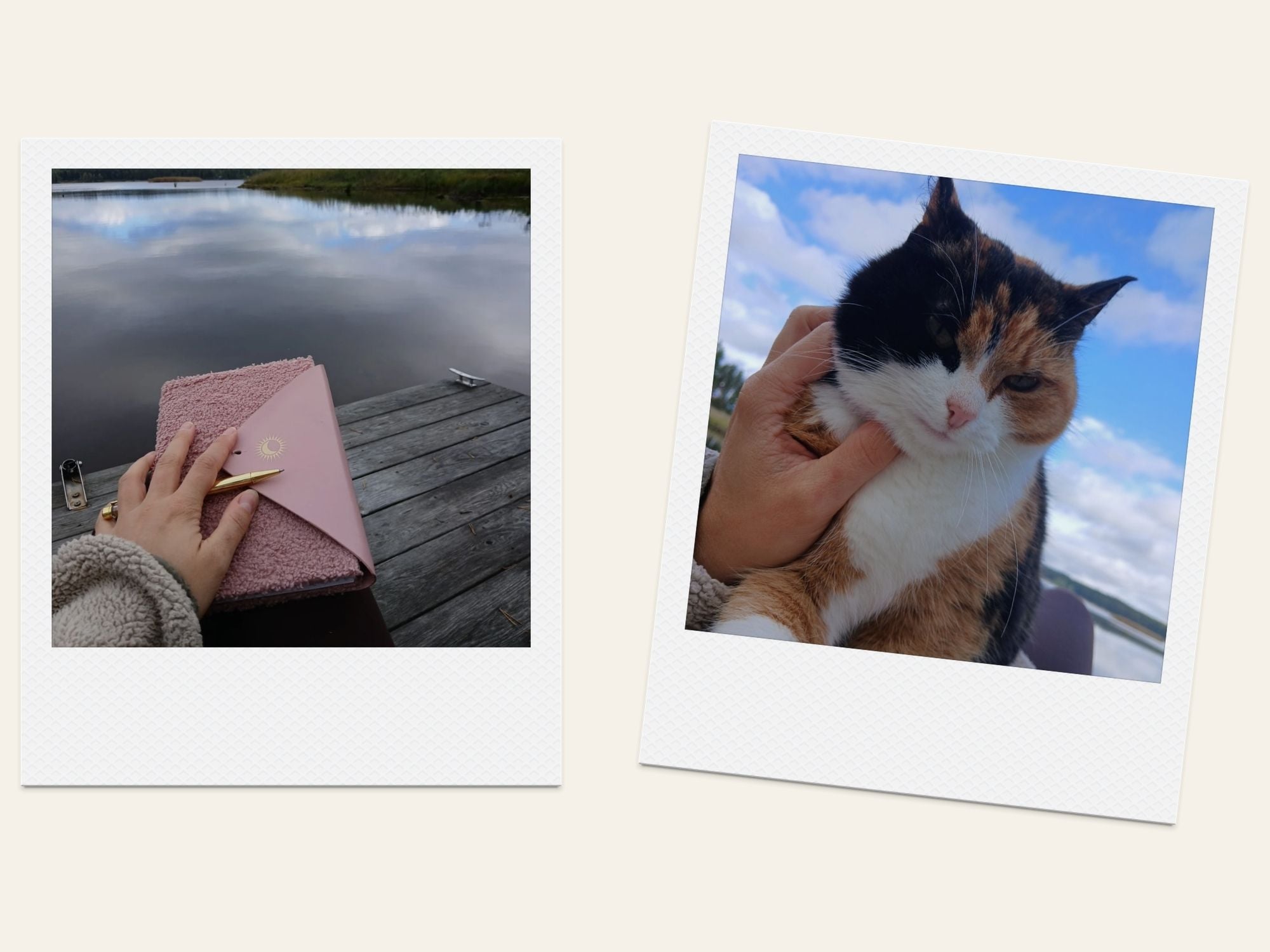
Being alone gave me space where someone else’s voice wasn’t constantly around me.
A relationship. Work. Friends. Social media. News. Music. Other people’s opinions, expectations and ideas about what I should do or what life should look like.
When a lot of that became quieter at the same time, suddenly there was much more space.
And I don’t want to make that sound easier than it actually was.
In the beginning, being alone could feel strange and honestly quite scary. I had never really known how to be alone, and there were also a lot of things happening in my life at the time that I had no choice but to sit with once so much of the outside noise disappeared.
It wasn’t some magical moment where everything became peaceful and I suddenly discovered a perfectly clear “inner voice” with all the answers.
But slowly, I started hearing myself better.
What do I think about this before I ask someone else? What do I actually like? What do I want? What don’t I want? What feels like mine when nobody else is there telling me what it should mean?
My identity and my life have changed so much in just the last few years that I don’t see the way I live right now as some final version of myself.
Maybe music will come back. Maybe something else will change again. I really don’t know.
But right now, this quieter phase feels important because it gives me space to hear what is happening underneath everything else.
This Isn’t About Removing Everything
It would be very easy to turn this into a post about deleting social media, never watching the news, switching off the TV and moving into the forest alone. 😂
Definitely not.
Music might be one of the most important things in someone’s life. Someone else genuinely loves reality TV. Another person wants to know exactly what is happening in the world. Social media can bring community, inspiration, information and people into our lives.
The question I find much more interesting is:
How consciously are we choosing what we consume?
Am I watching this because I genuinely want to watch it? Am I opening an app intentionally or automatically? Does this content still feel good to me, or am I consuming it simply because I always have?
And maybe even more importantly:
How do I feel afterwards?
I don’t think everything we consume needs to be meaningful, educational or somehow “good for us.” If a completely pointless TV show makes you laugh for two hours, maybe that’s exactly what you needed. 😄
But there is a difference between choosing something because we genuinely want it and automatically filling every empty moment with something.
What Happens If We Don’t Fill Every Quiet Moment?
Maybe this is the part that has changed the most for me.
I used to feel much more like empty space needed to be filled. Music in the car. The TV on. Phone in my hand. Something in the background. Something to think about.
I don’t feel the same need to fill every moment anymore.
And in that quiet, I’ve started noticing things that might otherwise have stayed underneath everything else.
My own thoughts. Ideas. Feelings. Things I genuinely want to do. Sometimes also things I’ve been trying not to think about.
Silence doesn’t always mean peace.
But maybe it doesn’t have to.
If our minds are constantly filled with other people’s words, opinions, stories and emotions, it can become difficult to notice what belongs to us underneath all of that.
Maybe We Just Need to Notice What We Let In
I don’t think any of us can live completely free from outside influence. People, culture, experiences and our environments inevitably shape us in different ways.
And I don’t think that’s a bad thing.
But maybe every now and then, we can look at what has accumulated in our minds in the same way we might look around a room we’ve been living in for years.
Do I still need this?
Do I actually like this?
Does this add something to my life, or is it simply a habit?
And most importantly:
Is there enough quiet space in my life for my own thoughts too?
Removing some of the noise hasn’t given me all the answers. I still don’t know exactly who I’ll be a few years from now or what else I’m going to discover about myself.
But maybe that’s another reason I want to leave some space to find out.
If your own voice feels a little lost underneath everything else, I created my free 10 Gentle Ways to Find Yourself Again guide for moments like this. It includes ten small ways to come back to yourself without needing to have all the answers or change your whole life at once
Get 10 Gentle Ways to Find Yourself Again
✨ Reflection: If you stopped filling every quiet moment with something from the outside, what do you think you might start hearing from yourself?
Sources & Further Reading
Petersen, S. E. & Posner, M. I. (2012). The Attention System of the Human Brain: 20 Years After. Annual Review of Neuroscience.
Firth, J. et al. (2019). The “online brain”: how the Internet may be changing our cognition. World Psychiatry.
A Small Note
This article is based on my personal experience, reflection and research. References to research are included for general educational purposes, and my own experiences are not meant to suggest that everyone will experience these things in the same way. This content is intended for self-reflection and inspiration and should not be considered medical or mental health advice.
