Learning to Let Go: Why We Hold On and How to Move Forward

Learning to Let Go: Why We Hold On and How to Move Forward
Have you ever found yourself holding on to something, even when you know deep down that it's no longer good for you?
Maybe it's a person you're afraid to lose, a relationship that doesn't feel the same anymore, or something from your past that you keep going back to in your mind. It could even be a future you once imagined for yourself but now have to learn to live without.
Sometimes we know, logically, that it's time to move forward. But knowing something and actually being able to do it are two very different things. We wait for answers, try one more time, or hope that something will change. And even when we understand the situation, we might still struggle to accept it.
I've spent a lot of time thinking about why letting go can feel so difficult, especially why we sometimes hold on to things that are causing us more pain than happiness. And if there's one thing I've had to learn throughout my own journey, it's how to let go.
I used to struggle with codependency and anxious attachment, and letting go of people was particularly difficult for me. I could understand that a situation wasn't good for me, but that didn't mean I knew how to walk away from it. I still wanted to try again, fix things, or find some kind of reassurance that it wasn't really over.
As I started learning more about myself and my patterns, I realized something important. If I wanted my life to change, I had to start making different choices, even when those choices felt uncomfortable. And for me, that's been a huge part of learning to let go.
Why Do We Hold On to Things That No Longer Serve Us?
There's often much more behind holding on than simply missing someone or feeling sad about something ending. Sometimes we think we're holding on because something means so much to us. But when we look a little deeper, we might discover that there are other reasons keeping us attached.
Here are some common ones:
- Fear of the unknown. We don't know what life will look like without a familiar person, situation, or routine.
- Hope that things will change. We keep waiting for something to become different, even when we've seen the same patterns repeat.
- Attachment and the need for connection. Losing a connection can feel especially difficult when relationships bring up feelings of insecurity.
- Shared history. The more time, love, and energy we've invested in something, the harder it can feel to walk away.
- Unanswered questions. We want explanations, closure, or one final conversation that will help us make sense of what happened.
- Our sense of identity. When a person, role, or situation has been a big part of our lives, we might not know who we are without it.
- Guilt. We may feel that letting go means giving up, abandoning someone, or not trying hard enough.
- The need for control. As long as we're trying to fix a situation, we can feel like there's still something we can do to change the outcome.
- Difficulty setting boundaries. When we're used to putting other people's needs before our own, taking a step back can bring up guilt or fear.
I can relate to so many of these, especially the feeling that there must still be something I could do to change a situation. But the more I've learned to let go, the more I've realized how much energy we can spend trying to change things that were never fully within our control.
The Psychology Behind Why Letting Go Feels So Hard
One of the most interesting things I've learned about myself has been understanding attachment. Attachment theory explores how our experiences of closeness, safety, and connection can influence the way we relate to others.
People with more anxious attachment tendencies may experience greater distress when a relationship feels uncertain or threatened. They may feel a strong need for reassurance, closeness, or confirmation that everything is okay. Research has also linked attachment anxiety with greater distress following romantic breakups.
Learning about this helped me understand my own behavior in a completely different way. Before, I didn't always stop to ask myself why I found it so difficult to leave certain situations alone. I just felt this overwhelming need to do something about them, whether that meant explaining myself, trying to fix things, or giving the situation another chance.
Once I started recognizing my attachment patterns, I became more aware of what was happening beneath those reactions. Was I actually trying to solve a problem, or was I trying to escape the uncomfortable feeling of uncertainty? What was I afraid would happen if I stopped trying? Those were questions I hadn't really known to ask myself before.
Why Does Uncertainty Make Us Search for Answers?
There's another psychological concept I find really interesting: intolerance of uncertainty. Research has found associations between difficulty tolerating uncertainty and higher levels of worry and anxiety.
Think about a situation where someone doesn't reply to your message. You might start wondering whether you've done something wrong, why they're acting differently, or whether you should send another message. You want an answer because you want the uncertainty to disappear.
But sometimes, constantly searching for answers keeps us emotionally connected to the very situation we're trying to move on from. One of my biggest realizations was that I don't have to resolve every uncertain situation before I can continue living my life. Sometimes letting go means learning to live without having all the answers.
Learning to Set Boundaries Was Part of Learning to Let Go
One of the biggest things I had to learn was how to set boundaries. For a long time, I didn't really have healthy boundaries in my relationships. I was so used to putting other people's feelings and needs before my own that I sometimes didn't even stop to think about what I wanted.
I struggled to say no. I worried about how other people would react if I disappointed them. I would adjust, compromise, and try to keep the peace, even when it meant ignoring my own feelings. Looking back, I can see how much of my behavior was driven by fear, especially the fear of losing people I cared about.
And perhaps the hardest part to admit was that I was sometimes so afraid of losing someone that I was willing to lose myself trying to keep them.
When I started learning about codependency and anxious attachment, I began to understand how closely my lack of boundaries was connected to my difficulty letting go. I'd spent so much time worrying about other people's reactions that I'd forgotten to ask myself a pretty important question: But what about me?
Learning to change those patterns wasn't easy. Especially in the beginning, saying no or putting my own needs first felt incredibly uncomfortable. Sometimes I felt guilty, even when I knew I hadn't done anything wrong. But over time, I started to understand that I could care about someone without constantly putting myself second. I didn't have to keep everyone happy, take responsibility for everyone else's emotions, or sacrifice my own needs just to keep someone in my life.
As I started setting boundaries and actually sticking to them, something shifted. I began trusting myself more and recognizing that my needs mattered too. For me, learning to set boundaries and learning to let go have gone hand in hand. The more I've learned to value myself and recognize what I need, the less I've felt the need to force things to stay in my life.
Why Do We Keep Wanting to Return to Old Patterns?
This is one of the most interesting parts of change to me. When I first started doing things differently, it didn't immediately feel good. Actually, it felt incredibly difficult. I wanted to go back to my old, familiar ways of dealing with uncertainty and uncomfortable emotions. Even though I knew I wanted things to change, my old reactions felt easier in the moment.
There's a psychological reason why changing familiar patterns can take time. Repeated behaviors can gradually become more automatic, especially when we keep responding to similar situations in the same way.
For example:
- When you feel insecure, you immediately look for reassurance.
- When someone pulls away, you try harder to bring them closer.
- When you feel guilty, you ignore your own boundaries.
- When a relationship ends, you repeatedly think about what you could have done differently.
- When an uncomfortable emotion appears, you immediately try to make it disappear.
Over time, these reactions can become so familiar that we barely notice we're repeating them. But patterns can change.
In a study on habit formation, researchers found that the time it took for new behaviors to become more automatic varied considerably, ranging from 18 to 254 days among the participants whose data could be modeled. The study focused on everyday health-related habits rather than relationship patterns, but it offers an interesting reminder that change often takes repetition.
And I think that's worth remembering when we're learning to let go. If you've spent years responding to certain situations in the same way, why would you expect yourself to change everything overnight?
The First Time I Didn't Go Back to My Old Ways
I still remember what it felt like when I first started putting everything I'd learned into practice. By that point, I'd already spent a lot of time learning about codependency, attachment patterns, and my own reactions. But understanding something and actually doing things differently were two completely different experiences.
When I found myself in a situation where I needed to respond differently than I normally would, it felt incredibly uncomfortable. Everything in me wanted to return to what was familiar, and it would have been so much easier to react the way I always had. But this time, I decided to stick with what I'd learned.
And afterward, something happened that I hadn't expected. It felt like something inside me had finally unlocked.
I'd done something that had previously felt almost impossible, and suddenly I realized that I actually could do it. There was this completely new feeling of freedom. For the first time, I could really see that I didn't have to keep letting the same fears and old patterns make my decisions for me.
Of course, I didn't learn everything at once. Old emotions and reactions still came up, and sometimes they still do. But every time I managed to respond more consciously, I became a little more confident in my ability to change. And slowly, life started to feel lighter.
Sometimes We're Holding On to a Future That Never Happened
I've also realized that letting go isn't always just about losing something from our past. Sometimes the hardest part is letting go of what we thought our future would look like.
The relationship we imagined would last. The plans we never got to experience. The life we'd already started building in our minds. When something ends, we might find ourselves grieving both what we had and what we thought was still ahead of us.
Sometimes it's that imagined future that keeps us holding on the longest. We replay conversations, think about what could have happened differently, and wonder whether things might still turn out the way we once hoped. But how long can we keep waiting for a future that no longer exists?
That's something I've had to think about in my own life. Sometimes moving forward begins when we stop making decisions based on what we hope someone else might eventually do and start asking ourselves what kind of life we want to create instead.
Letting Go of the Need to Control Everything
One of the biggest changes in my mindset has been learning to release the need for control. I used to spend so much energy trying to understand other people's behavior or find solutions to situations I couldn't actually change.
But at some point, I started asking myself a different question: Why am I spending so much time thinking about what someone else is doing when I could be using that energy to build my own life?
I can't decide how someone else behaves, change the past, or make another person understand things the same way I do. But I can decide how I respond. I can learn to set boundaries, choose where I put my time and energy, and make decisions that feel right for me, even when I don't know exactly how everything will turn out.
That shift has brought so much more peace into my life. The less I try to control everything around me, the more energy I have for the things I can actually influence.

Trust That What's Meant for You Will Find You
There's also a spiritual side to letting go that has become really meaningful to me. I believe that when we release what no longer serves us, we create space for what's meant to come into our lives. New experiences, new connections, unexpected opportunities, and maybe even parts of ourselves we haven't discovered yet.
And there's one thought I've learned to trust more and more: What's meant for you will find its way to you. You don't have to hold on to it with all your strength.
Sometimes we spend so much energy trying to keep people, situations, or opportunities in our lives. We're afraid that if we loosen our grip, even for a moment, we might lose something important. But what if we didn't have to fight so hard to keep everything? What if we trusted ourselves and life a little more, even when we couldn't see what was coming next?
For me, this has been an incredibly freeing way to look at things. I don't want to live constantly afraid of what I might lose. I want to trust myself, trust life, and believe that things will find their place. If something no longer belongs in my life, I can allow it to leave. I don't have to chase, force, or control everything.
You cannot lose what is truly meant for you. And you don't have to force what no longer belongs on your path.
When you begin to trust this, letting go can slowly become something different. Instead of seeing it only as a loss, you can begin to see the possibilities it creates: the possibility of growing into someone new, discovering what you really want, and allowing life to surprise you.
Sometimes it's only when we finally loosen our grip on the past that we realize how much space there is for everything still waiting ahead. 🤍
What Can Help You Start Letting Go?
Letting go isn't something you have to master in a day, and it doesn't always happen through one big decision. Often, it begins with small changes in the way we think, respond, and make choices.
Here are a few things worth paying attention to:
- Recognizing your patterns. Do you keep finding yourself in similar situations or responding in ways you wish you could change?
- Understanding what you're really holding on to. Is it the person, the feeling of security, the hope that things will change, or the future you imagined?
- Learning to tolerate uncertainty. Not every question will have an answer, and not every situation can be resolved.
- Strengthening your boundaries. Sometimes letting go also means learning to take your own needs seriously.
- Changing familiar reactions. A new way of responding may feel uncomfortable at first, even when you know it's better for you.
- Allowing yourself to feel. You can miss something and still choose to move forward. Conflicting emotions can be part of the process.
- Bringing your attention back to your own life. The more energy you put into what you can influence, the more room you create for your own growth.
For me, one of the most important lessons has been realizing that I don't have to wait until every uncomfortable feeling disappears before I can make a different choice. Sometimes that first different choice is the hardest one.
How Do You Know You're Starting to Let Go
Letting go doesn't always happen in one big, life-changing moment. Sometimes you only notice it afterward.
Maybe something that used to occupy your thoughts all day doesn't have the same hold on you anymore. Maybe you realize you're no longer waiting for a message, an explanation, or an apology the way you once did. You might find that you can think about the past without feeling the need to return to it.
Or perhaps you find yourself in a familiar situation and suddenly notice that you're responding differently. For me, that last one has been one of the biggest signs of change. Realizing that something that once felt almost impossible no longer controls my behavior in the same way is when I can really see how far I've come.
And it's a pretty incredible feeling.
You Don't Need All the Answers to Move Forward
If I could go back and tell my younger self something, especially the version of me who held on so tightly to people and situations, I think it would be this: You don't have to spend all your energy trying to make something stay in your life.
Not everything is your responsibility. And just because something once meant so much to you doesn't mean you aren't allowed to grow beyond it.
Learning to let go has brought a completely different kind of freedom into my life. The freedom to make my own decisions, to be myself, and to allow things to unfold without constantly trying to control the outcome. And perhaps most importantly, the freedom to trust that I'll be okay even when life doesn't go the way I planned.
Sometimes the biggest change begins when you finally dare to do one thing differently and realize that life goes on. Maybe even a little lighter.
Ready to Begin Your Own Letting Go Journey?
I know from personal experience how difficult letting go can be, especially after a painful breakup, when your mind is full of unanswered questions, your emotions are all over the place, and a part of you just wants to go back to what feels familiar.
Throughout my own journey, I've tried different ways of processing emotions, understanding myself, and learning to let go. I've spent time writing, reflecting, challenging old patterns, and learning to make different choices. Over time, I discovered exercises and approaches that genuinely helped me.
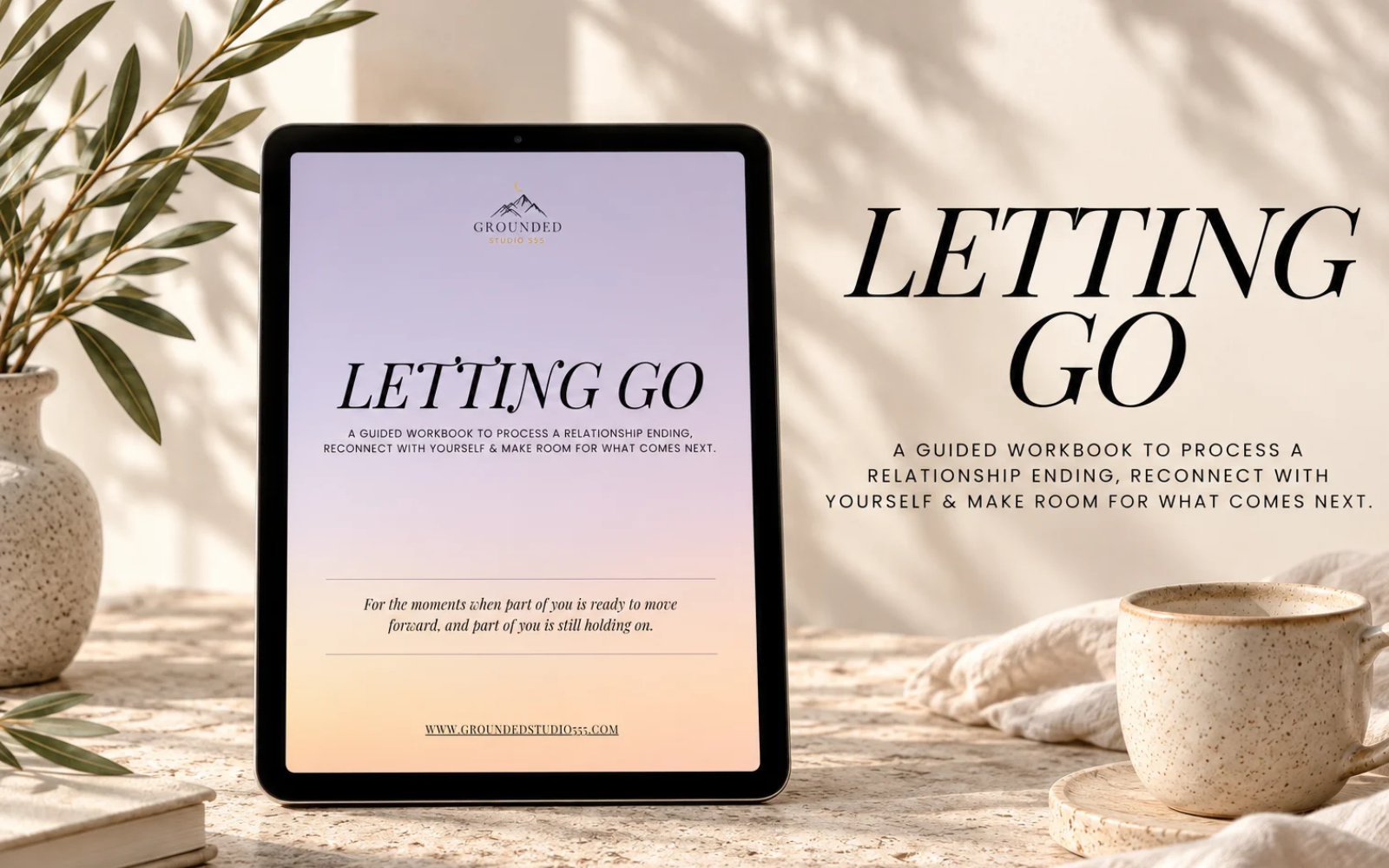
And that's how Letting Go Journey was born.
I wanted to bring together the exercises I've personally tried and found helpful along the way. Not just pages of questions to fill in and forget about, but different ways to explore your feelings, understand what you're holding on to, and slowly begin moving forward.
This workbook is for you if you know it's time to let go but aren't quite sure how. If you keep finding yourself going back to the same thoughts or old patterns, or if you're ready to start putting more of your energy into yourself and what you need.
I can't do the letting go for you. But I can share the tools that helped me learn how to do it myself.
If you're ready to take that first step toward a new chapter, I'd love for you to explore Letting Go Journey. 🤍
->Explore Letting Go Journey
❤️ S / GS555
Sources
Lally, P., van Jaarsveld, C. H. M., Potts, H. W. W., & Wardle, J. (2010). How are habits formed: Modelling habit formation in the real world. European Journal of Social Psychology, 40(6), 998–1009.Mikulincer, M., & Shaver, P. R. (2016). Attachment in Adulthood: Structure, Dynamics, and Change (2nd ed.). Guilford Press.Carleton, R. N. (2016). Into the unknown: A review and synthesis of contemporary models involving uncertainty. Journal of Anxiety Disorders, 39, 30–43.