Intuition or Fear? How to Tell the Difference and Learn to Trust Your Gut

Intuition or fear? How to tell the difference and learn to trust your gut
Have you ever met someone and immediately felt that something wasn't quite right, even though you couldn't explain why? Or maybe you've been about to make a decision that felt right deep down, while your mind kept coming up with reasons not to do it.
We often call this intuition, our inner voice, or simply a gut feeling. But how do we know when we're listening to our intuition and when we're actually listening to fear? Sometimes a feeling can be so strong that we're convinced it must mean something. Other times, we question ourselves so much that we lose track of what we really want.
I've spent a lot of time thinking about this over the past few years. The more I've learned about myself, the more curious I've become about where our thoughts, feelings, and reactions come from. And especially how we can learn to listen to ourselves without letting fear make all our decisions.
What is intuition, really?
Intuition is often described as something mysterious. Almost like a sixth sense that tells us things we couldn't possibly know. But there's also a psychological side to it.
In simple terms, intuition is a quick understanding or judgment that happens without consciously working through every step of the reasoning process. Our brains are constantly processing information, comparing new situations with past experiences, and recognizing patterns. Sometimes this happens so quickly that we don't even realize how we've reached a conclusion. That's why we might suddenly feel that something is right or wrong without being able to explain exactly why.
Psychologists Daniel Kahneman and Gary Klein explored this in their research on intuitive expertise. They found that intuition can become more accurate through experience, especially in situations where people have opportunities to recognize meaningful patterns and learn from feedback.
Think about someone who has years of experience in their profession. They might notice that something isn't working before they can identify the actual problem. Their mind has learned to recognize certain patterns through experience. Something similar can happen in everyday life. You might notice something in another person's tone of voice, facial expressions, or behavior that doesn't quite match what they're saying. You can't necessarily explain what you've noticed, but something feels off.
Of course, intuition isn't always right. Our past experiences, fears, and beliefs can influence how we interpret situations. Sometimes our minds recognize patterns that aren't actually there. And here's something I find particularly interesting: feeling certain about something doesn't necessarily mean we're correct. That's why I think intuition is worth listening to, but it doesn't mean we should stop questioning our assumptions or looking at the facts.
What does intuition feel like? Understanding your gut feeling
The expression gut feeling describes something many of us have experienced: a feeling that seems to come from somewhere deeper than our conscious thoughts. Sometimes it's a strange sensation in your stomach. Sometimes it's a moment of hesitation you can't explain. Other times, it's a strong feeling that you want to do something, even though you have no idea where it might lead.
You might experience intuition as a sudden sense that something feels right, an unexpected hesitation, or a feeling of being drawn toward a particular choice. But here's where things get interesting. A feeling in your stomach doesn't automatically mean your intuition is speaking. Excitement, nervousness, stress, and fear can create physical sensations too.
There's actually a scientific term for our ability to sense what's happening inside our bodies: interoception. Interoception involves noticing and interpreting internal bodily signals, including sensations related to our heartbeat, breathing, and stomach. Research suggests that these internal signals are connected to how we experience emotions and understand our bodily states. But those sensations don't always tell us exactly what we're feeling or why.
You've probably heard people say that intuition feels calm while fear feels loud and urgent. Personally, I don't think it's always that simple. An intuitive impression might make you afraid. And fear can sometimes feel so convincing that you mistake it for a warning.
Maybe the important question isn't just what you're feeling, but where that feeling might be coming from.

How I started learning to listen to myself
A few years ago, my life changed in ways I never expected. I found myself questioning things I'd always taken for granted. And for the first time, I really started asking myself who I was and what I actually wanted from life.
For a long time, other people's needs, expectations, and opinions had influenced many of my choices. When I started recognizing those patterns, I also realized how difficult it could be to separate my own wishes from my fears. Did I genuinely want something, or was I just trying to avoid disappointing someone? Did something feel wrong because it wasn't right for me, or because I'd never dared to try it before?
I became increasingly interested in psychology, intuition, and understanding how our minds work. Spirituality also became a bigger part of my life. Tarot, journaling, and different self-reflection practices gave me new ways to explore my thoughts and feelings.
Over time, I started realizing that listening to yourself doesn't mean being completely certain about every decision. Sometimes it means being willing to make a choice without knowing exactly how things will turn out.
Why fear can feel like intuition
Fear has an important purpose. It helps us recognize potential threats and respond to them. But we don't only experience fear when we're in physical danger. We can also be afraid of failing, being rejected, disappointing someone, or losing something familiar.
Starting a new job, traveling alone, setting boundaries, or making a major life change can bring up a surprising amount of uncertainty. And sometimes our past experiences influence what feels threatening today.
For example, if you've experienced rejection before, you might interpret someone's distance as a sign that they no longer care about you. But the actual reason for their behavior could be something completely different. Your feelings are real, but your interpretation of the situation might not be accurate.
One of the biggest changes in my own life has been learning to do things I might never have dared to do before. I've traveled alone, made major changes in my life, and started building my own business. I couldn't know in advance how everything would turn out. If I'd waited until I wasn't afraid anymore, I probably would have missed out on a lot of experiences.
These days, I try to ask myself:
Does this feel wrong because it genuinely isn't right for me, or am I afraid because I don't know what happens next?
That doesn't mean ignoring fear. Sometimes fear is pointing toward a real risk that deserves our attention. But not every uncomfortable feeling is a sign that we should turn around.
Does everyone experience intuition the same way?
You've probably heard the advice: Trust your gut. Listen to your inner voice. Sleep on it and see how you feel tomorrow. But have you ever wondered what listening to your intuition actually means? And what if it doesn't work exactly the same way for everyone?
I believe we all have intuition. It's not some special ability that only a few people are born with. But recognizing it can be difficult, especially if we've spent years ignoring our feelings, questioning ourselves, or constantly looking for reassurance from others.
Maybe strengthening your intuition isn't about trying to make your inner voice louder. Maybe it's about learning to recognize how it speaks to you.
This is one of the reasons I've become interested in Human Design. In Human Design, there's a concept called Inner Authority. The idea is that different people have different ways of finding clarity when making decisions.
For some, clarity might come with time, after they've had a chance to experience different emotions. For others, it might appear as an immediate physical response. Someone else might understand what they really want only after hearing themselves talk about it out loud.
According to my own Human Design chart, I have Splenic Authority, which is described as a quick, instinctive feeling that appears in the moment. I've found this an interesting perspective when exploring my own intuition and the way I make decisions.
And think about how often we give people advice based on what works for us. We tell a friend to sleep on it, trust their first instinct, or think things through a little longer. But what helps one person find clarity might not necessarily work the same way for someone else.
I'd love to explore the different Inner Authorities in Human Design in a separate blog post, because there's so much more to this topic. For now, I want to leave you with one thought:
What if you're not bad at listening to your intuition? What if you simply haven't learned to recognize how it speaks to you yet?
And that's something we can start exploring. The more attention we pay to our feelings, reactions, and decisions, the more familiar our own inner world can become.
How to strengthen your intuition and learn to trust your gut
I don't think strengthening your intuition means blindly trusting every first impression. For me, it's more about learning to recognize my reactions, understand my patterns, and reflect on my experiences. Here are six practical ways you can start exploring your own intuition.
1. Start With Small Decisions
If you're used to asking everyone else for their opinion, try starting with small everyday choices. What do you actually feel like doing today? Where would you like to go? What sounds enjoyable to you?
Before asking someone else what they think, give yourself a moment to notice your own preference. You don't need to turn every little decision into a big exercise. The idea is simply to notice how often you look outside yourself for answers before checking what you want.
2. Pay Attention to How Your Body Responds
The next time you're making a decision, take a moment to notice what's happening in your body. Do you feel tension in your stomach? Does your breathing change? Does one option bring up excitement, nervousness, or discomfort?
You don't need to immediately decide what those sensations mean. Just notice them. Over time, you might begin recognizing how your body responds to different situations and emotions. And remember, a physical sensation isn't proof that something is right or wrong. It's simply another piece of information you can explore.
3. Keep an Intuition Journal
This is one of my favorite ideas for getting to know your own patterns. Whenever you experience a strong gut feeling or sudden first impression, write it down.
Ask yourself:
- What was happening?
- What was my first feeling?
- What did I think that feeling meant?
- What did I decide to do?
- What happened afterward?
Then come back to your notes later. Was your first impression accurate? Could an old fear have influenced your reaction? Did you notice something you couldn't explain at the time?
And don't only look for the moments when your intuition seemed right. Pay attention to the times when your first impression turned out to be wrong, too. That's how you begin learning about your own reactions instead of simply assuming every gut feeling must be correct.
4. Separate Facts From Assumptions
When something brings up a strong emotional reaction, try dividing a page into three sections.
What do I know for sure?
What am I assuming or afraid of?
What don't I know yet?
For example, if someone hasn't replied to your message, the only thing you know for certain is that they haven't replied. The thought that they're angry with you or no longer care about you is an interpretation. It might turn out to be true, but you don't actually know that yet.
This simple exercise can help you notice when your mind starts filling in missing information based on previous experiences or fears.
5. Spend Some Time Without Constant Distractions
How often do we actually spend time alone with our thoughts? Our phones, social media, music, podcasts, and other people's opinions can easily fill almost every quiet moment.
I've personally noticed how important it is for me to have some space to think without constantly taking in something new. You could try going for a walk without headphones, sitting outside for a while, or simply resisting the urge to reach for your phone the moment things get quiet.
You don't have to remove every distraction from your life. Just give yourself a little space to notice what you're thinking, feeling, and needing.
6. Practice Trusting Yourself Without Knowing the Outcome
Sometimes we wait for complete certainty before allowing ourselves to make a decision. But the truth is, there are plenty of situations in life where we simply can't know how things will turn out.
We can gather information, consider our options, and listen to ourselves. And still, there might be uncertainty. I think learning to trust yourself isn't necessarily about always making the right decisions.
It's also about realizing that you can handle situations even when things don't go according to plan. You can make a choice, learn something, and change direction if you need to. You don't have to get everything right the first time.
Learning to trust your intuition starts with understanding yourself
When I think about my life a few years ago, I realize how much my relationship with uncertainty has changed. I used to want to know what was coming next. I wanted reassurance that the decisions I made would lead somewhere good. But life doesn't always give us those answers.
Little by little, I've learned to accept that I don't need to know everything in advance. I can still make my own choices, explore new possibilities, and change direction if something no longer feels right for me.
I don't see intuition as some perfect inner guide that can never be wrong. For me, it's one more way of getting to know myself and noticing things I might not have paid attention to before.
And maybe that's where strengthening your intuition really begins. Not by trying to find an explanation for every feeling or waiting for a clear sign telling you what to do. But by becoming genuinely curious about your own thoughts, needs, and reactions.
The better we understand ourselves, the easier it may become to recognize when fear is influencing our choices and when something genuinely matters to us.
Want to understand yourself a little better?
If you often find yourself questioning your decisions, ignoring your own needs, or getting stuck in your thoughts, sometimes the best place to start is simply giving yourself space to reflect.
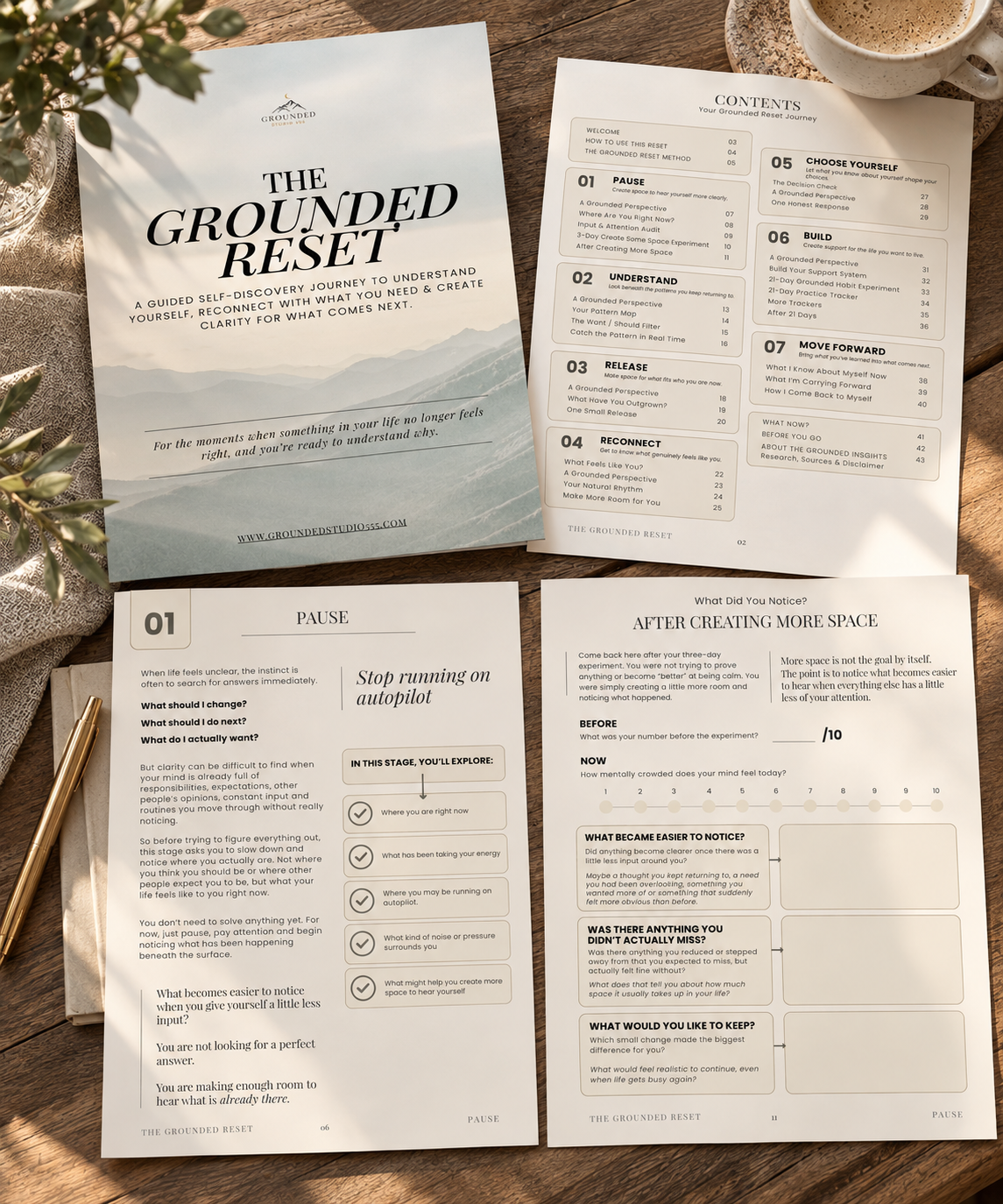
That's one of the reasons I created The Grounded Reset. It's a guided workbook designed to help you explore your feelings, recognize your patterns, reconnect with your needs, and think about what you actually want moving forward.
It's not about changing your entire life overnight or finding all the answers at once. Sometimes asking yourself the right questions is enough to start seeing things from a different perspective.
Explore The Grounded Reset and take a little time to reconnect with yourself.
A Little Reflection
Think about the last time you had a strong feeling that something was right or wrong, even though you couldn't explain why. What happened when you listened to that feeling? And what happened when you ignored it?
What is one small thing you could do today to start trusting yourself a little more?
❤️ S / GS555
Sources
The following research informed the psychological explanations of intuition, pattern recognition, and bodily awareness in this article.
1. Kahneman, D., & Klein, G. (2009).
Conditions for Intuitive Expertise: A Failure to Disagree.
American Psychologist, 64(6), 515–526.
This research explores when intuitive judgments can become reliable through experience and why confidence alone doesn't guarantee accuracy.
2. Khalsa, S. S., et al. (2018).
Interoception and Mental Health: A Roadmap.
Biological Psychiatry: Cognitive Neuroscience and Neuroimaging, 3(6), 501–513.
This paper examines how we sense and interpret signals from inside our bodies and how those processes relate to emotional experiences.
3. Desmedt, O., et al. (2023).
The New Measures of Interoceptive Accuracy: A Systematic Review and Assessment.
Neuroscience & Biobehavioral Reviews.
This review examines research methods used to study how accurately people perceive internal bodily signals.